AI Agent: How It Works, Use Cases, Comparison with AI Chatbots
Key Takeaways
- An AI Agent is an autonomous AI system that can perceive its environment, reason, plan, and execute multi-step processes without requiring human intervention at every step.
- The core difference between an AI Agent and an AI Chatbot lies in the level of autonomy. An AI Chatbot answers questions within its connected data, while an AI Agent independently queries systems, processes transactions, and completes entire workflows.
- In customer service, an AI Agent can automatically receive a request, look up order details, verify policies, process a refund, and send confirmation in sequence — with agents only needing to monitor the outcome.
Every day, your customer service team repeats the same workflow dozens of times: receive a request, look up information, check policies, process the request, and send confirmation. If an AI system could complete this entire chain of steps on its own while your team simply monitors the results, agents would have time to focus on situations that require individual judgment. So what is an AI Agent, and how does it differ from the AI Chatbot your team is already using?
What Is An AI Agent?
An AI Agent is an artificial intelligence software system capable of autonomously perceiving its environment, reasoning, planning, and executing a chain of multi-step actions to achieve a specific goal. Unlike an AI Chatbot that only answers questions, an AI Agent independently carries out an entire process from start to finish.
How Are AI Agents And Chatbots Different?
AI Agents and AI Chatbots both apply artificial intelligence, but their levels of autonomy and scope of action differ significantly. The table below summarizes six core differences:
| Criteria | AI Chatbot | AI Agent |
|---|---|---|
| Primary function | Answer questions and provide information | Plan and execute multi-step processes |
| Level of autonomy | Responds when prompted by the user | Proactively plans and carries out actions |
| System interaction | Generates text-based responses | Calls APIs, updates databases, creates support tickets |
| Scope of action | Single question → single answer | Multi-step workflow from intake to completion |
| Learning ability | Limited to connected training data | Can improve over time with memory and feedback |
| Best for | FAQs, request classification, information delivery | Returns processing, order management, service renewals |
In other words, an AI Chatbot fits when a team needs to answer questions and provide information. An AI Agent fits when a team needs to automate an entire handling process from intake to completion. In practice, many teams combine both: the AI Chatbot handles the front line (answering questions, classifying requests), then passes complex tasks to the AI Agent for execution.
How Does An AI Agent Work?
This technology operates on four core components working together:
- Perception: Collects data from its surroundings, including customer messages, order data, and system statuses.
- Reasoning: Uses a large language model (LLM) as its "brain" to analyze situations, break tasks into smaller steps, and plan execution step by step.
- Action: Automatically executes by calling APIs, updating databases, sending messages, or creating support tickets in connected systems.
- Learning: When the system is designed with memory or a feedback loop, the agent records outcomes and uses them to handle similar situations better. In most business deployments, this improvement also comes from the team regularly updating the knowledge base and instructions.
Thanks to these four components, an AI Agent behaves more like an autonomous team member than a tool waiting for commands. You assign a goal, and the agent plans and completes it on its own. Customer service teams can learn more about how AI supports improving customer service efficiency in daily operations.
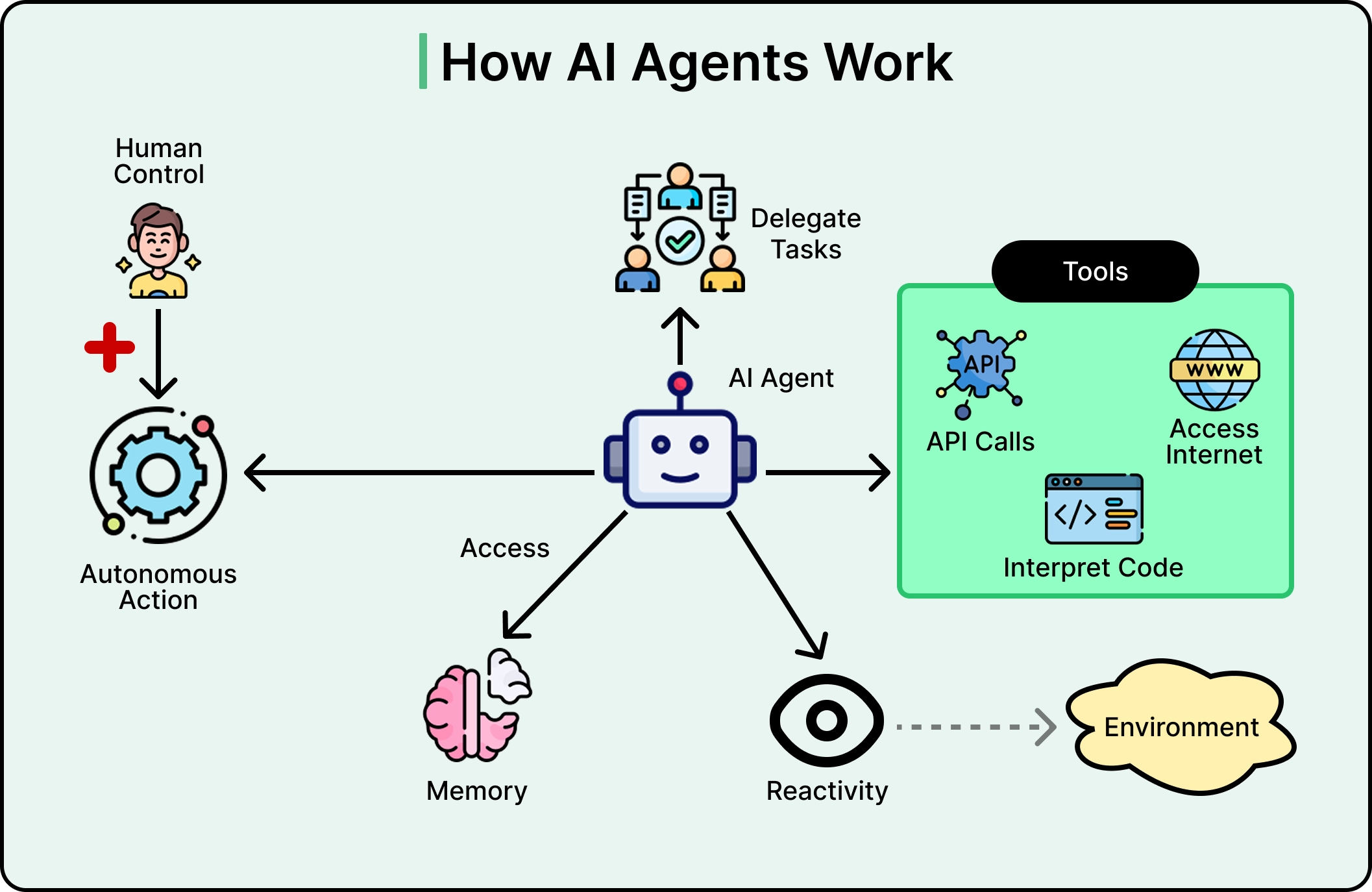
Here are the specific operational steps of an AI Agent:
Step 1: Perceive The Situation
An AI Agent begins by collecting data from its environment. In customer service, input data includes customer messages across chat channels, notifications from order management systems, CRM data, and support ticket statuses.
Based on the collected data, the agent determines the current context. For example, it recognizes that a customer is sending a request related to a return, a refund, or a product inquiry. This step mirrors how a human agent reads a message and identifies the request type before taking action.
Step 2: Reason And Plan
After perceiving the situation, the AI Agent uses a large language model (LLM) as its "brain" to analyze customer intent and build an action plan. The agent breaks the task into specific steps rather than processing everything at once.
For example, upon receiving a return request, the agent builds a plan: look up order number → check return policy → create a return ticket → send confirmation to the customer. Beyond that, the agent also evaluates alternatives if a step hits an obstacle (expired order window, product requiring physical inspection).
Step 3: Execute Actions
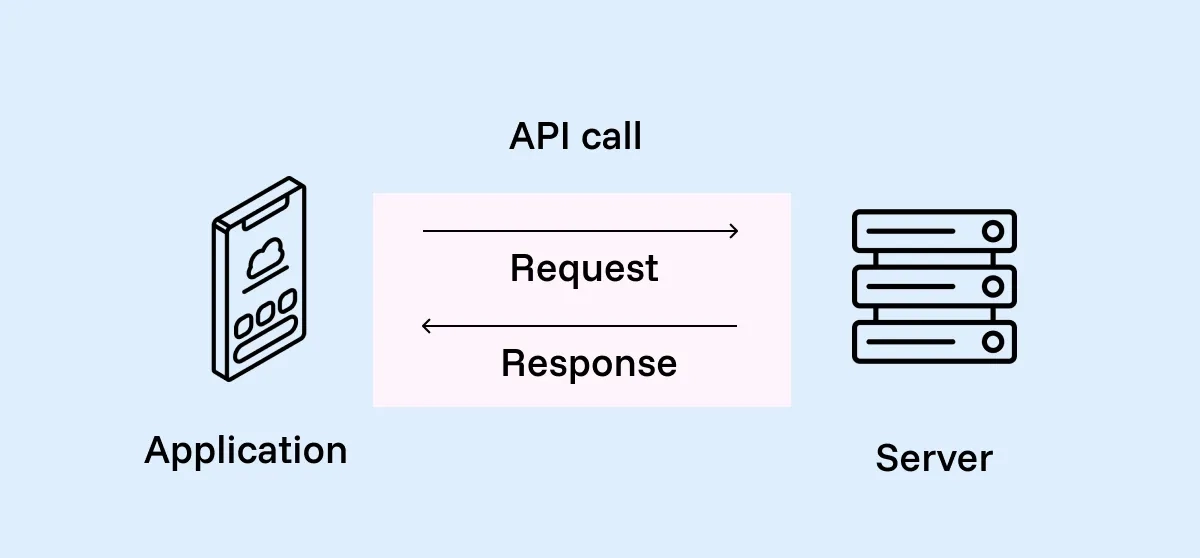
The AI Agent executes each step in the plan by calling software tools. This is the biggest difference compared to an AI Chatbot, because the agent interacts directly with multiple systems rather than only generating text responses.
Actions the agent can perform include:
- Calling order system APIs: Look up statuses, update information, or create new tickets
- Accessing customer databases: Verify information, log interaction history
- Sending confirmation messages: Respond to customers through the appropriate chat channel with situation-specific content
- Internal notifications: Alert the responsible agent when monitoring or intervention is needed
Step 4: Evaluate And Adjust
After each action, the AI Agent checks the result and compares it against the original goal. If the result falls short, the agent adjusts its approach before moving to the next step.
If the agent is built with memory, it can log outcomes and draw on them for similar cases later. In practice, much of the improvement comes from the team reviewing results and updating the agent's knowledge base and instructions, which is why AI Agents can get better over time instead of staying fixed like a script-based chatbot.
What Benefits Does An AI Agent Bring To Customer Service Teams?
Now that you understand what an AI Agent is, the next step is evaluating the practical benefits it delivers in daily operations. An AI Agent helps customer service teams automate multi-step processes, reduce request handling time, improve first-contact resolution rates, and free up agents to focus on situations requiring individual judgment.
Teams that deploy AI Agents typically see four clear improvements:
- Shorter request handling time: The agent completes lookup, verification, and processing steps in seconds instead of the minutes it takes when an agent handles each step manually.
- Higher first-contact resolution (FCR): The agent retrieves complete information before responding, so customers receive an accurate answer on their first contact instead of waiting for an agent to verify.
- Reduced repetitive workload for agents: Processes with clearly defined steps (returns, order checks, service renewals) are handled automatically by the agent. Human agents focus on complex complaints, negotiations, and situations requiring individual judgment.
- Consistent performance across every channel: The AI Agent processes requests with the same workflow regardless of whether the customer contacts through Zalo, Facebook Messenger, WhatsApp, or email. Platforms like SaleSmartly let teams run the same AI Agent and automation workflows across all these channels from a single inbox.
When Should You Use An AI Agent?
Understanding what an AI Agent is helps teams identify the right use cases. In Vietnam, AI Agent adoption is shifting from traditional Q&A tools to "digital employees" capable of independently planning and executing complex task chains, according to VnEconomy. Below are the four most common use cases where B2B teams in Vietnam are deploying AI Agents:
- Automating contact centers and 24/7 customer service: Platforms like FPT AI Agent and iSense Agentic CX are being deployed in Vietnam to automate contact centers, summarize calls, and score process compliance. In chat-based customer service, the agent receives requests, looks up orders, checks policies, and processes transactions (returns, refunds, service renewals) while human agents only need to monitor the final outcome.
- Supporting multichannel sales and marketing: The AI Agent automatically analyzes customer behavior, qualifies leads from popular channels in Vietnam (Zalo, Messenger, website live chat), generates need summaries, and passes them to the sales team along with recommended next actions. Beyond that, the agent personalizes follow-up content for each customer segment based on multichannel interaction data.
- Coordinating data across internal systems: When a customer contacts the team, the agent simultaneously queries the CRM, order management system, and internal data warehouse to compile complete information before responding. This reduces the time agents spend switching between software tools — a common application for SaaS and B2B service companies in Vietnam.
- Serving cross-border customers: The agent handles requests in multiple languages and looks up policies specific to each market.
However, when an AI Agent acts autonomously, teams need strict access controls and monitoring to keep customer data secure. Vietnam's Law on Artificial Intelligence (Law No. 134/2025/QH15), effective March 1, 2026, also requires that users be clearly informed when they are interacting with an automated AI system, and emphasizes human oversight in important decisions. For customer service teams, that means disclosing AI-handled conversations and always keeping a clear path to a human agent.
SaleSmartly: The Channel And Customer Data Layer For Your AI Agents
An AI Agent is only as useful as the conversations it can reach and the customer context it can see. SaleSmartly provides both. It brings every customer channel into one place, runs AI-powered conversations on top, and opens its customer data to the AI Agents and systems your company already uses.
- AI Agent powered by the model you choose: Connect ChatGPT or DeepSeek, or bring an agent you've built on Coze or Dify. Add a custom system prompt and a knowledge base with your product catalog, FAQs, and pricing. The AI Agent answers routine questions, qualifies leads, and hands complex cases to the right team member across Zalo, Facebook Messenger, Instagram, WhatsApp, TikTok, LINE, Telegram, Email, and website live chat.
- AI intent recognition that triggers the right workflow: When a customer sends a message, AI recognizes their intent and starts the matching workflow. From there, rule-based trigger → condition → action steps you build with drag and drop handle tagging, routing, follow-ups, and escalation the same way every time. No coding is required.
- Customer data your internal agents can query: Through the SaleSmartly API, your company's own AI Agents and internal systems can pull customer profiles, tags, and conversation history from SaleSmartly, so every agent works from the same customer record.
- Webhooks to trigger the next step: SaleSmartly pushes conversation events, such as new messages, tag changes, or status updates, to your other systems as they happen.
- One inbox for AI and human agents: When the AI Agent hands off, a human picks up in the same thread with the full history, and can assign, transfer, add internal notes, and track status from open to resolved.
- Real-time translation in 136 languages: Customers write in their own language and your agents reply in theirs, which suits B2B teams serving cross-border markets.
Where SaleSmartly fits: SaleSmartly handles the customer-facing side: intake, intent recognition, answers, routing, handoff, and the customer record behind every conversation. Executing transactions inside your ERP or order system, such as the refund workflow described earlier, happens in the AI Agent or back-end automation you connect to it. SaleSmartly feeds that agent context through the API and triggers it through webhooks.
Learn more about how SaleSmartly helps customer service teams automate omnichannel workflows, or compare plans.
Conclusion
What is an AI Agent? It is an autonomous AI system capable of perceiving, reasoning, planning, and executing multi-step processes in sequence — with human agents only needing to monitor the outcome. Compared to an AI Chatbot that answers questions, an AI Agent independently queries systems, processes transactions, and completes entire workflows from start to finish.
Your customer service team can start by automating the most repetitive process on the channel with the highest interaction volume, then expand gradually once results stabilize. Contact SaleSmartly to learn how to build omnichannel customer service automation workflows that fit your team.
What Is A Chatbot? Types, Use Cases And How To Deploy For Customer Service Teams
A chatbot is software that simulates conversations with customers via text or voice. Learn the types, benefits, and how to deploy chatbots for your CS team.
Facebook Chatbot: How To Create And Set Up Scripts For Your Fanpage
Step-by-step guide to creating a Facebook chatbot for your fanpage with sample scripts (greeting, pricing, returns) and principles for effective conversation flows.
