AI Chatbot: How It Works, Benefits And How To Deploy
Key Takeaways
- AI chatbots use natural language processing (NLP) and large language models (LLM) to understand customer intent from open-ended questions, rather than requiring them to select from pre-built menus.
- RAG (Retrieval-Augmented Generation) technology connects AI chatbots to your shop's own data (price lists, policies, inventory status), improving first contact resolution (FCR) by 35-50% compared to systems without RAG.
- The global AI customer service market is projected to grow from $9.5 billion (2023) to nearly $48 billion by 2030, reflecting the rapid adoption of AI chatbots in customer service operations.
A customer messages "I want to change the color on my order from yesterday" and expects an immediate answer with specific instructions for their exact order. This is the type of request that script-based chatbots struggle with because the question does not match any pre-built menu. So what is an AI chatbot and what technology enables it to handle complex situations like this?
What Is An AI Chatbot?
An AI chatbot is software that uses artificial intelligence to analyze intent from customers' open-ended questions and generate responses tailored to each specific context. Rather than operating on fixed question flows, AI chatbots use natural language processing (NLP) and large language models (LLM) to understand many different ways of expressing the same need.
Customers may ask about inventory status, delivery times, or return requests using a wide variety of phrasing, and an AI chatbot recognizes the intent behind each message to respond appropriately. LLM technologies such as ChatGPT (OpenAI), Google Gemini, and Claude (Anthropic) are now being widely integrated into AI chatbot systems for customer service.
An important distinction is that AI chatbots focus on answering questions and providing consultation within the scope of connected data. For more complex workflows (automatically checking orders, processing refunds, updating CRM), AI agents are more suitable because they can independently execute multiple steps in sequence.
How Does An AI Chatbot Differ From A Traditional Chatbot?
AI chatbots process natural language to understand intent, while traditional chatbots match keywords or guide users through menus. The table below summarizes six core differences between the two systems:
| Criteria | Traditional Chatbot | AI Chatbot |
|---|---|---|
| Input processing | Keyword matching or menu selection | NLP analyzes intent, entities, and context |
| Response capability | Fixed responses from scripts | Generates new responses tailored to each situation |
| Out-of-script questions | Asks customer to re-select or transfers to agent | Analyzes and responds even to unprogrammed questions |
| Knowledge updates | Team manually edits scripts | Connects via RAG to automatically update from new data |
| Multilingual | Requires separate scripts per language | Handles multiple languages from a single model |
| Scaling cost | Increases linearly with number of scripts | Expands coverage by adding data |
In practice, many customer service teams combine both systems. Traditional chatbots quickly handle FAQs with fixed answers, while AI chatbots take on open-ended questions and personalized consultation.
How AI Chatbots Work
AI chatbots run on three technology layers working together, including the first layer helping the chatbot understand language, the second generates natural responses, and the third connects the chatbot to your shop's own data.
Natural Language Processing (NLP)
NLP (Natural Language Processing) enables AI chatbots to convert customer questions from natural language into data the system can process. This involves two main steps:
- Intent recognition: Determining what the customer wants. For example, "can I exchange the size" and "I want to switch to a larger size" are both recognized as the intent "return/exchange."
- Entity extraction: Identifying specific information in the question such as product name, size attribute, or order number.
Through these two steps, the AI chatbot understands the content of a question regardless of how the customer phrases it.
Large Language Models (LLM)
LLM (Large Language Model) is the foundation that enables AI chatbots to write responses in natural language rather than sending fixed text blocks. These models are trained on massive language datasets, producing responses that are coherent, grammatically correct, and contextually appropriate.
In customer service, LLMs allow chatbots to adjust response tone for each channel. Additionally, LLMs handle multiple languages from a single model, enabling teams to serve international customers without building separate scripts for each language.
Retrieval-Augmented Generation (RAG)
RAG (Retrieval-Augmented Generation) addresses a critical limitation of standalone LLMs: the model may write grammatically correct responses that contain inaccurate information about your specific products and policies.
RAG works by connecting the LLM to your own data sources. Before generating a response, the system queries your price lists, return policies, inventory status, or purchase history. As a result, responses are both natural (thanks to the LLM) and accurate (thanks to real data). Industry research shows that LLM+RAG systems improve first contact resolution (FCR) by 35-50% compared to systems without RAG.
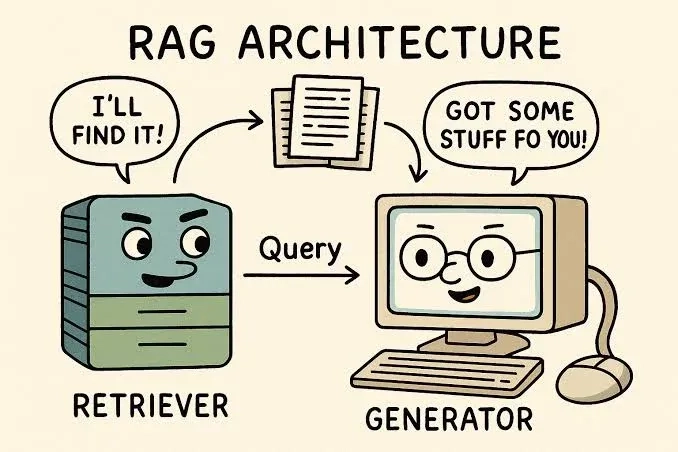
Teams can set up RAG connections to their shop data through the automation feature using a drag-and-drop interface.
What Benefits Do AI Chatbots Bring?
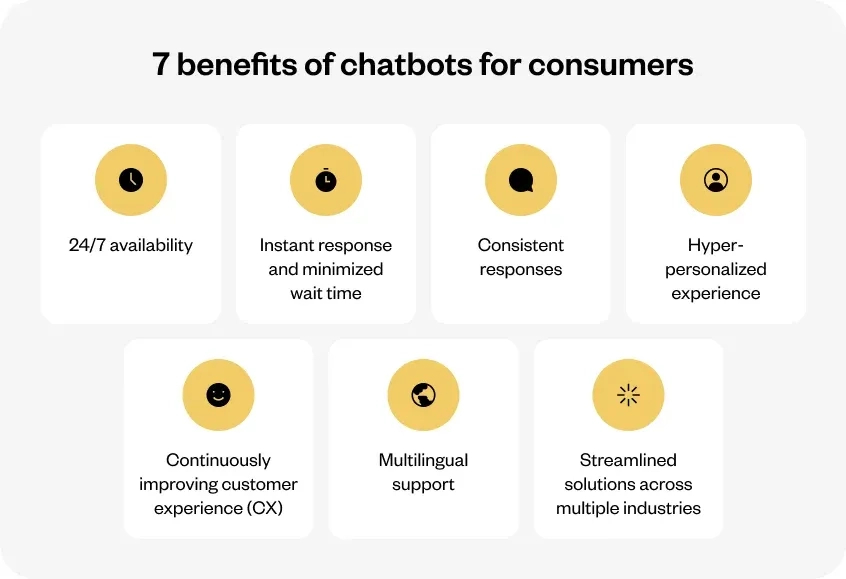
AI chatbots deliver the highest value when your customer service team needs to handle diverse questions, serve multilingual customers, or personalize responses based on purchase data. According to Yahoo Finance, the global AI customer service market is projected to grow from $9.5 billion (2023) to nearly $48 billion by 2030, indicating that AI chatbots are becoming a standard tool in customer service operations.
Customer service teams deploying AI chatbots typically see four clear improvements in daily operations:
- Handling questions outside pre-configured scripts: Customers ask in natural language and receive appropriate responses instead of being asked to re-select from a menu. This significantly reduces the number of conversations that need to be transferred to agents.
- Accurate product information through RAG: AI chatbots query price lists, inventory status, and policies before responding, helping customers receive correct information on their first contact. Platforms like SaleSmartly allow you to connect multi-model AI chatbots (ChatGPT, DeepSeek, Coze, Dify) with product data and conversation history from all channels.
- Automatic multilingual customer service: LLMs process multiple languages from a single model, helping cross-border shops improve customer service efficiency with international customers without needing agents fluent in each language.
- Continuous improvement in response quality: AI chatbots analyze conversations where the system did not respond well, enabling teams to supplement data and fine-tune the model. Quality improves progressively each week of operation rather than remaining static.
When Should You Use An AI Chatbot?
AI chatbots are most effective when customer requests exceed the capabilities of fixed scripts. Below are four scenarios where AI chatbots create clear value for your team.
- Personalized product consultation: Customers describe their needs in natural language and the AI chatbot suggests suitable products based on catalog data. Traditional chatbots can only display product lists by category.
- Post-sale support with full context: AI chatbots combine RAG to look up orders, purchase history, and return policies before responding. As a result, customers receive specific answers for their exact order.
- Lead screening and classification for sales teams: On website live chat, AI chatbots ask flexible screening questions (budget, scale, timeline) then route classified leads along with a needs summary to the appropriate salesperson.
- Serving cross-border customers: AI chatbots process conversations in multiple languages without the team needing foreign language skills.
How Does SaleSmartly Support AI Chatbot Deployment?
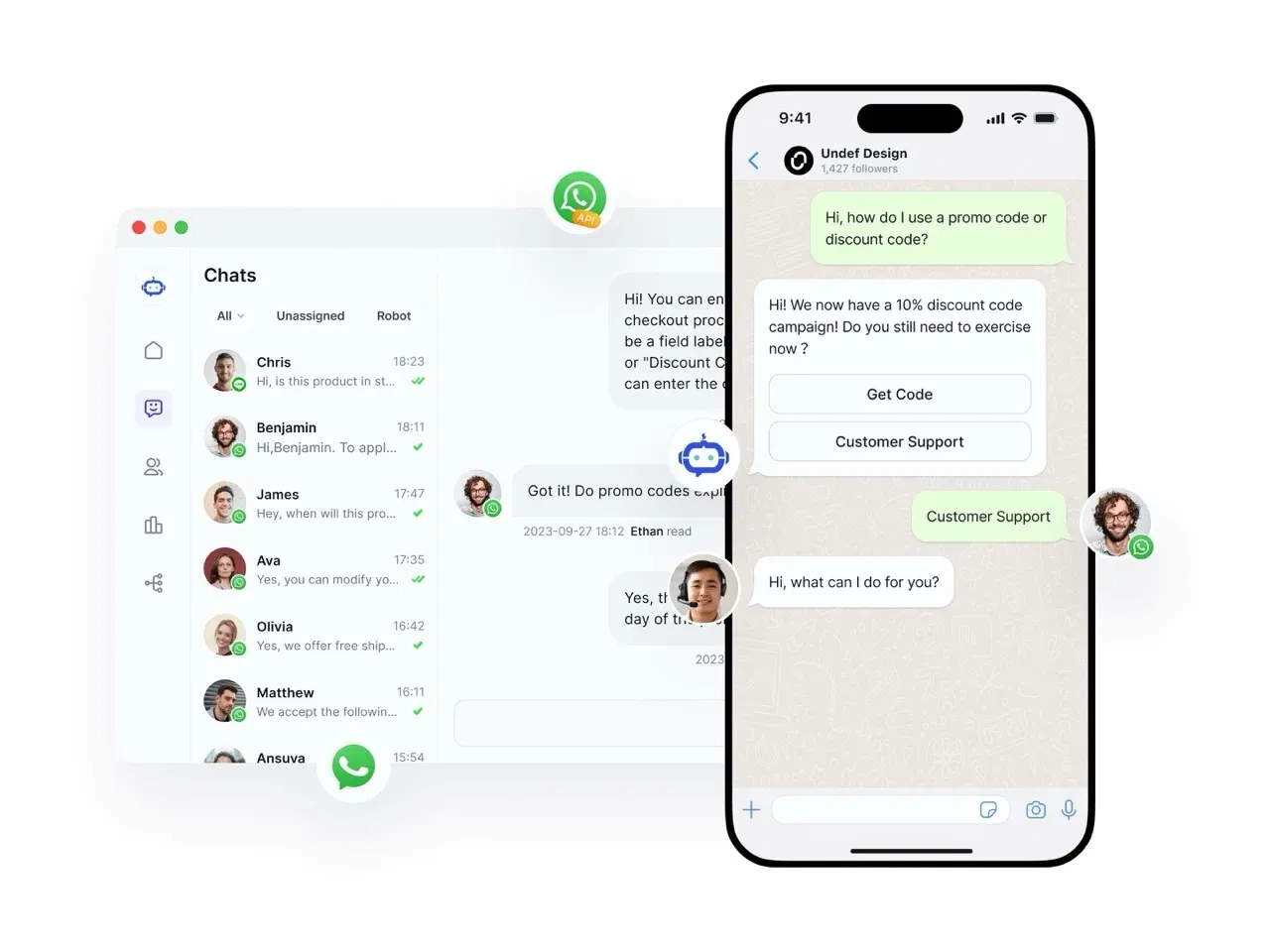
SaleSmartly provides a platform for deploying AI chatbots with multiple AI models across all popular chat channels, from Zalo, Facebook Messenger, and Instagram to WhatsApp, Telegram, and website live chat.
Your customer service team can operate AI chatbots on SaleSmartly with three core capabilities:
- Multi-model AI connection: Integrate ChatGPT, DeepSeek, Coze, or Dify depending on each channel's needs. Your team chooses the right model rather than being limited to a single technology.
- RAG with shop data: The chatbot queries your price lists, policies, and FAQs before responding, ensuring answers are accurate based on real information.
- Real-time translation across 130+ languages: Agents read and respond to messages in their native language while the system automatically translates to the customer's language.
For voice AI chatbot needs or deep integration into complex backend systems (ERP, banking systems), specialized solutions like Amazon Lex, Google Dialogflow, or VNPT AI are more suitable.
Experience SaleSmartly today!
Conclusion
Your customer service team can start deploying an AI chatbot by connecting RAG to three critical data sources: product price lists, return policies, and FAQs. Run it alongside agents for the first 2-3 weeks on the channel with the highest message volume, monitoring the rate of questions the chatbot handles accurately. Once that rate stabilizes, expand to remaining channels and add more product data in phases.
FAQs
How Do You Use An AI Chatbot?
Start by connecting the AI chatbot to your shop's product data and policies via RAG, deploy it on the channel with the highest message volume, then review conversations the chatbot did not handle well on a weekly basis to supplement data. During the initial phase, keep both the chatbot and agents running in parallel to verify response quality.
Which AI Chatbot Platforms Are Popular In Vietnam?
Several AI chatbot platforms supporting Vietnamese include VNPT AI, FPT.AI, Bizfly Chat, and SaleSmartly. Many customer service teams in Vietnam also integrate ChatGPT or DeepSeek into their chat systems on Zalo and Facebook Messenger through APIs or intermediary platforms.
What Are The Types Of AI Chatbots?
AI chatbots are classified by processing technology into three groups. NLP chatbots recognize intent and entities from questions. LLM chatbots (based on large language models) generate flexible responses based on context. RAG chatbots combine LLM with your shop's own data to respond accurately about pricing, inventory status, and policies.
What Is An AI Chatbot Used For?
AI chatbots help customer service teams automatically answer customer questions outside business hours, recommend products based on individual need descriptions, look up order information for each specific customer, and serve customers in multiple languages without agents needing foreign language skills.
Online Customer Service Strategies For Omnichannel Teams
Guide to online customer service via Zalo, Facebook, Instagram, WhatsApp, and live chat. Strategies, workflows, and tools for omnichannel shops in Vietnam.
What Is A Chatbot? Types, Use Cases And How To Deploy For Customer Service Teams
A chatbot is software that simulates conversations with customers via text or voice. Learn the types, benefits, and how to deploy chatbots for your CS team.
