What Can AI Actually Do in Customer Service?
In today’s customer service landscape, customers expect instant responses 24/7 across every platform. As these expectations continue to rise, traditional customer support models are starting to reveal their limitations: slow response times, high operational costs, and difficulty scaling efficiently.
AI is not replacing human agents. Instead, it is becoming the operational layer that helps customer service teams work faster, smarter, and more consistently. So what exactly can AI help with in customer service workflows? Let’s explore how businesses are applying AI in real-world support operations.
What Can AI Help With in Customer Service Workflows?
AI Automates Customer Responses 24/7
Most customer inquiries revolve around a relatively small number of common scenarios: asking about pricing, delivery times, return policies, or order confirmations. AI can handle these repetitive conversations effectively without requiring agents to stay online at all times — even at 2 AM or during public holidays by automated responses.
This not only reduces customer waiting time, but also frees support teams from repetitive tasks so they can focus on situations that require human judgment, empathy, and problem-solving.
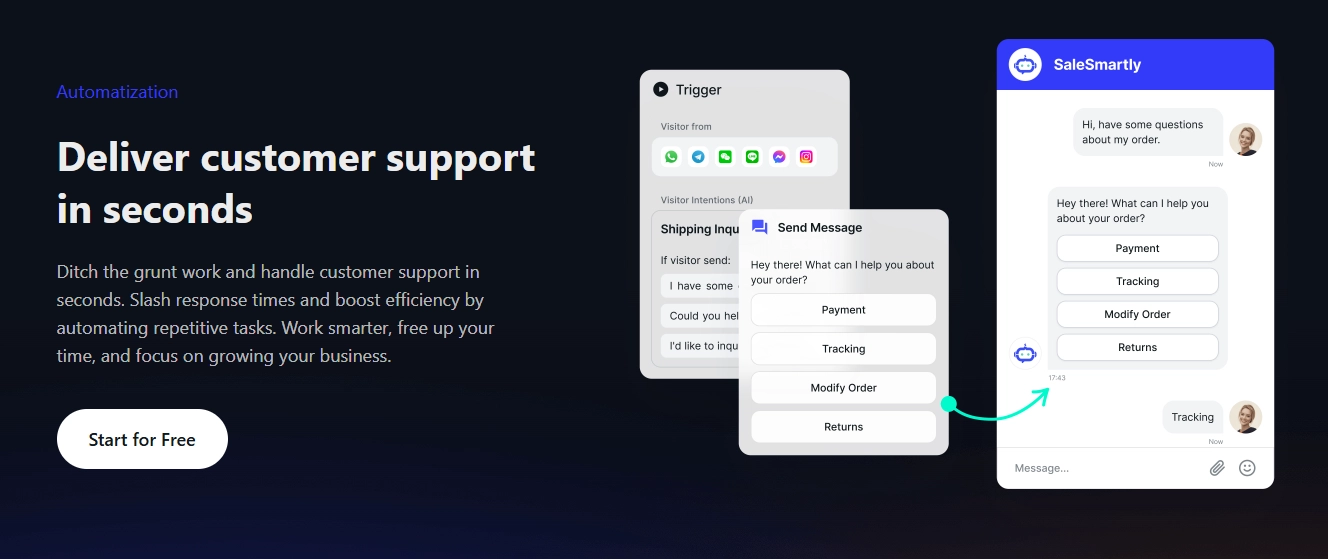
AI Intelligently Classifies and Prioritizes Conversations
Not every customer message requires immediate attention. AI can identify and prioritize conversations based on urgency and business value, such as:
- Frustrated customers → require immediate intervention
- High-intent buyers → should be routed to sales teams quickly
- Silent customers after a service issue → churn risk, proactive follow-up needed
- Routine inquiries → can remain in the normal support queue
Instead of using a simple “first-come, first-served” approach, AI helps support teams focus on the conversations that matter most — reducing the risk of missing important customers during peak hours.
AI Helps Support Agents Respond Faster and More Accurately
AI is not only about automation. It can also function as an intelligent assistant for customer service agents.
AI can support teams by:
- Suggesting response drafts
- Translating conversations in real time
- Summarizing long chat histories
- Recommending relevant replies
- Retrieving customer information instantly
This improves response speed while maintaining consistency across support operations.
AI Personalizes Customer Experiences Based on Conversation History
Personalization has become essential for improving customer experience and retention. AI can analyze purchase history, customer behavior, and conversation context to generate more relevant responses instead of sending the same generic scripts to every customer.
For example, customers who previously purchased Product A can automatically receive recommendations for related Product B.
This creates a more personalized and contextual customer experience rather than a purely transactional interaction.
AI Handles Repetitive Tasks So Human Teams Can Focus on Complex Cases
AI chatbots are highly effective for repetitive and rule-based workflows such as:
- FAQ responses
- After-hours customer support
- Conversation classification
- Automated notifications
- Workflow routing
These operational tasks consume significant time but often do not require human decision-making.
As a result, support agents can focus on higher-value responsibilities such as:
- Complaint resolution
- VIP customer support
- Complex consultations
- High-value sales opportunities
When implemented properly, AI reduces repetitive workload while allowing teams to focus more on customer experience and revenue growth.
Common Mistakes Businesses Make When Implementing AI Chatbots
Over-Automating Customer Interactions
Not every customer service situation should be automated.
Chatbots work well for predictable requests such as FAQs, order confirmations, and standardized information. However, when customers are frustrated about a failed order or need guidance during a complex purchase decision, bots cannot replace human flexibility and empathy.
The problem is usually not the chatbot itself. The issue is that businesses fail to clearly define where automation should stop and where human intervention becomes necessary.
Without these boundaries, the support experience becomes inconsistent and impersonal — eventually damaging customer trust, even if the product itself is good.
A practical principle is:
- Standardized questions → handled by AI
- Situations requiring judgment or emotional understanding → handled by humans
Operating Without Centralized Conversation Data
AI does not become intelligent automatically. It learns from customer conversation data.
If customer conversations are fragmented across Facebook, WhatsApp, Instagram, email, and multiple disconnected systems without centralized storage or structure, even a well-configured chatbot will only operate at a basic level.
This is a common infrastructure mistake: businesses invest in AI before building centralized customer communication systems.
As a result:
- AI cannot improve over time
- Customer inquiry trends remain invisible
- Operational decision-making becomes limited
- Customer experiences stay fragmented
A unified omnichannel communication system — where every interaction is stored, structured, and accessible in one place — is a foundational requirement before advanced AI capabilities can deliver meaningful results.
Ignoring Human Escalation Workflows
This is one of the most common and damaging failures in real-world chatbot deployment.
A typical scenario looks like this:
- The customer asks something outside the bot’s capabilities
- The bot cannot resolve the issue
- The conversation never reaches a human agent
- The customer keeps receiving repetitive automated responses
This does not simply frustrate customers. It completely breaks the trust businesses have built through previous customer touchpoints.
A properly designed AI customer service system should include three clear layers:
- Detection layer: The bot recognizes when it has reached its operational limitations
- Escalation layer: Conversations are transferred to the correct human agent with full context attached
- Continuity layer: Human agents continue the conversation seamlessly without forcing customers to repeat information
This is one of the biggest differences between enterprise-grade AI systems and basic chatbots.
How SaleSmartly Uses AI in Customer Service
For many businesses, AI is treated as an additional feature. In practice, however, AI only becomes effective when combined with centralized conversation management and unified customer data. This is exactly how SaleSmartly approaches AI-powered customer service operations.
In addition to AI chatbots, SaleSmartly provides features that help businesses manage customer support more systematically, including:
- Centralized storage of customer conversation history
- Customer tagging and lead classification
- Agent response performance tracking
- Automated customer service workflows
- Omnichannel customer data synchronization
Instead of combining multiple disconnected tools, businesses can manage their entire customer communication workflow within a single platform.
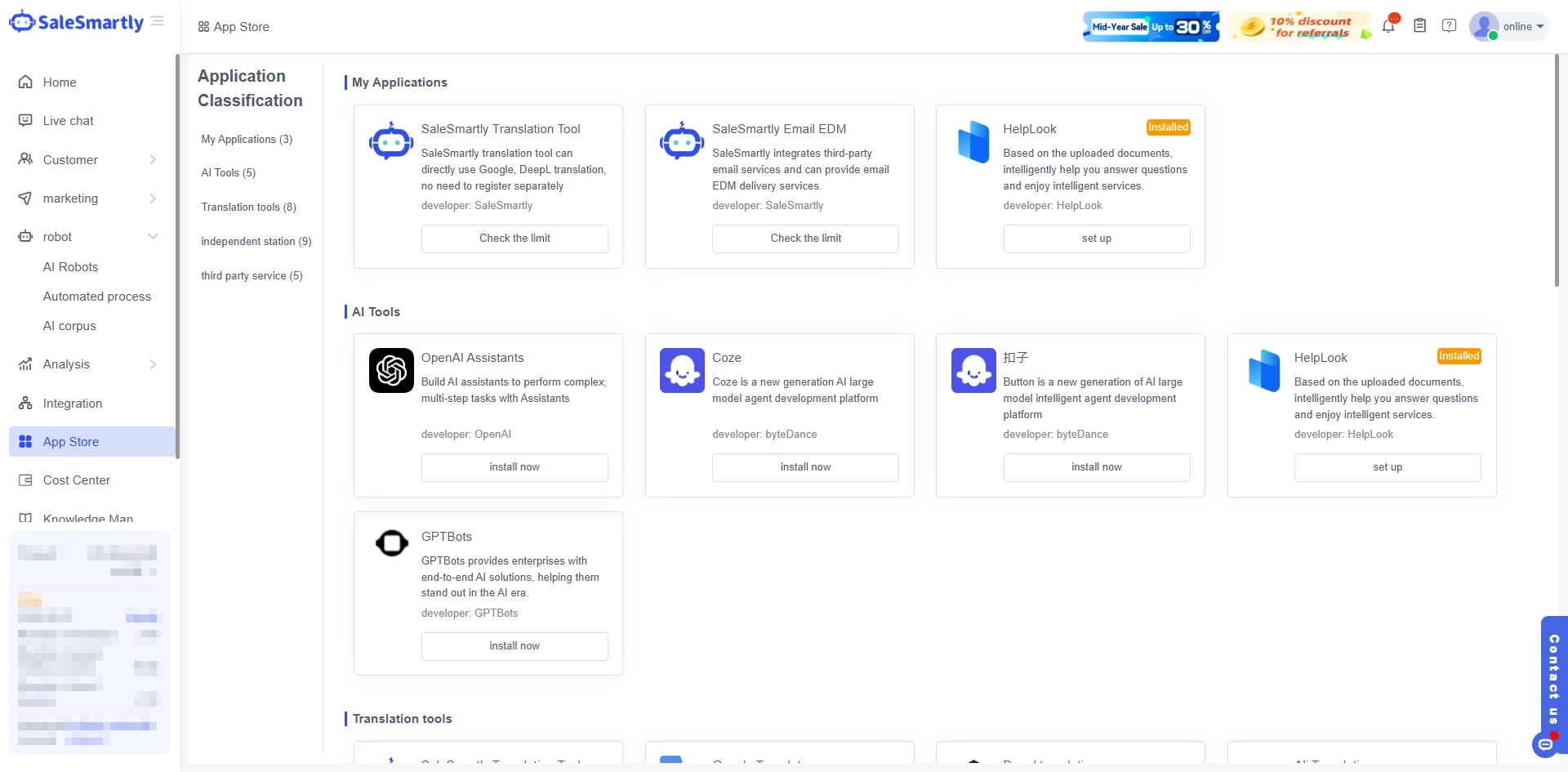
This is one of the reasons why SaleSmartly is widely used by omnichannel and cross-border businesses handling large volumes of customer conversations every day without continuously expanding support headcount.
More than 10,000 businesses are already using SaleSmartly to manage thousands of customer conversations daily — faster, with fewer agents, and without leaving customers waiting.
👉 Try SaleSmartly for free at salesmartly.com and experience AI-powered customer service automation without requiring a credit card.
6 AI Features to Speed Up Your Customer Service Team — SaleSmartly
6 AI features embedded directly in the chat window help customer service teams translate, process voice messages, extract image text, and generate smart replies — faster responses, less manual work.
Prevent Customer Loss When Your Sales Rep Leaves the Company
A 12-person Hai Phong machinery exporter can lose 30-50 active accounts in a single resignation. Here is how WhatsApp Business API, plus a unified inbox, turns personal numbers into company assets.
