What Is Upsell? Techniques, Timing, And Common Mistakes
A customer who has already decided to buy is not the same customer who was browsing five minutes ago. Once the buying decision is made, the mental resistance to spending more drops significantly, and this is the window every retail brand, SaaS company, and hospitality business has learned to exploit for decades. The technique is called upsell, and it consistently drives more incremental revenue than most acquisition campaigns because your team is working with warm intent instead of cold interest.
What Is Upsell?
Upsell is the sales technique of persuading a customer to buy a higher-priced version, larger size, or upgraded package of a product or service they were already planning to purchase, to increase order value and revenue per customer.
The mechanics of upsell rely on timing: the offer appears when the customer has already committed mentally to buying something, so the psychological cost of adding value is lower than the cost of making a first decision. A customer at the checkout page is not a stranger anymore, and treating them differently from a first-time visitor is what separates effective upsell from generic promotion.
Three things distinguish upsell from other sales tactics:
- Sequence matters: Upsell happens after the customer signals purchase intent, not during initial discovery when they might still walk away.
- Same product category: The upgrade offer sits inside the same product family the customer is already considering, not a different category.
- Clear value delta: The reason to upgrade needs to be concrete enough that the customer understands what they gain, not just what they pay more for.
Upsell shows up in almost every industry, from F&B combo suggestions to SaaS tier upgrades to consumer electronics storage upsizing. What differs across industries is the specific tactic, not the underlying principle.
Real Examples Of Upsell
Three examples show how upsell operates in familiar industries and help translate the concept into recognizable patterns your team can adapt:
- Food and beverage: Your customer orders a medium coffee, and the cashier suggests upgrading to a large for 20% more, offering 40% more drink volume. The math is deliberately favorable to the customer.
- SaaS subscriptions: A user signs up for the Personal plan, and during checkout the software surfaces the Family plan with 5 seats, framed as "less than a fifth of the cost per person if you already share with family members."
- Consumer electronics: A customer picks the iPhone 128GB, and the store rep explains photo and video storage needs over 3-5 years of use, then recommends the 256GB version for a specific dollar difference.
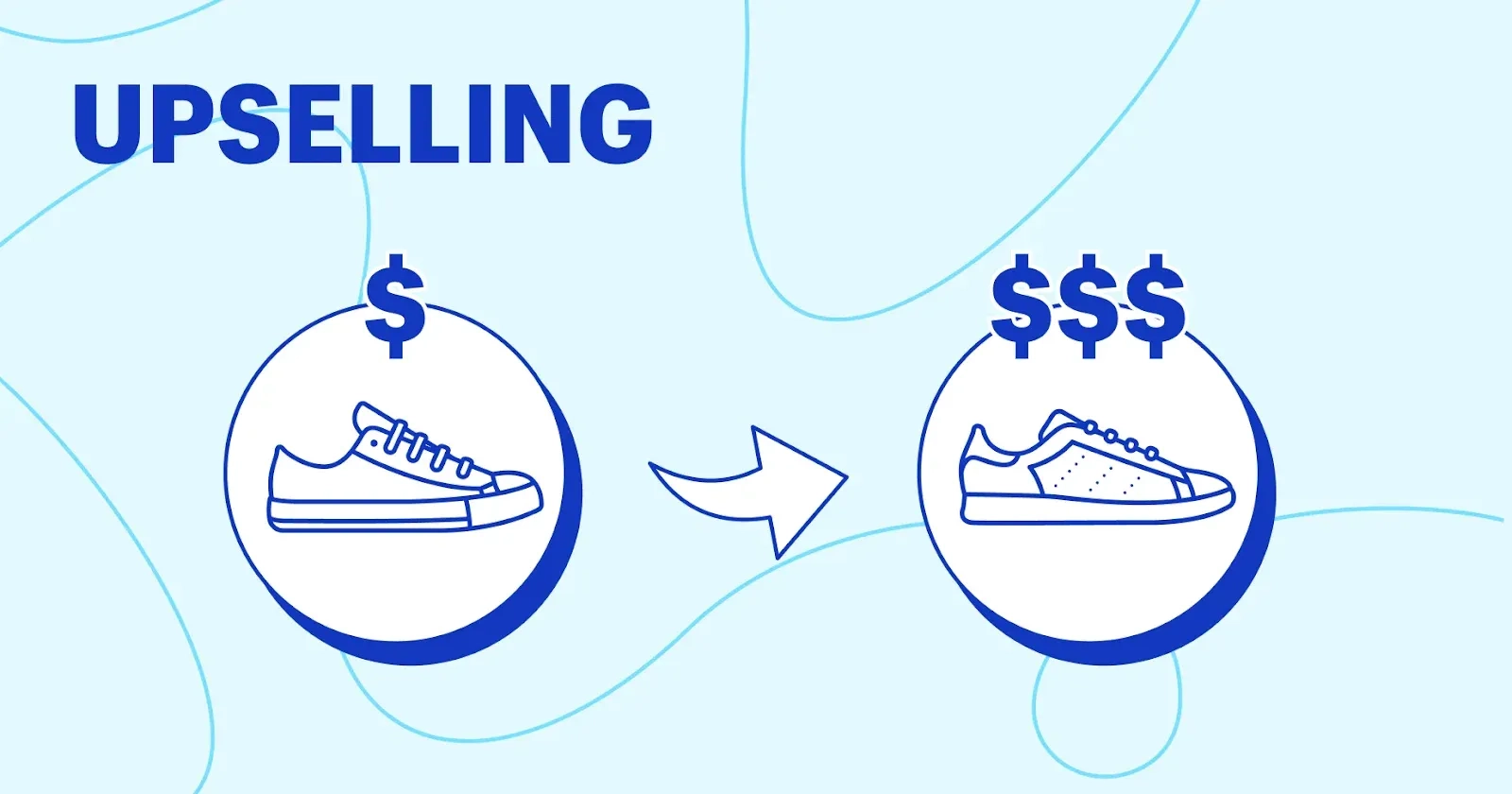
The pattern across all three: upsell arrives when the customer is committed, the upgrade sits in the same product family, and the pitch attaches a concrete value reason to the higher price rather than pushing quantity for its own sake.
Upsell vs Cross-Sell: Which To Use When
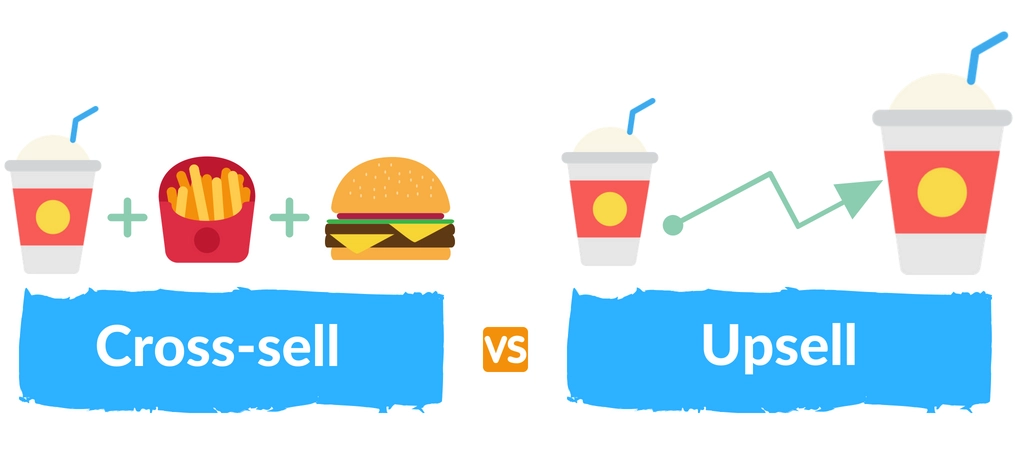
Cross-sell suggests additional accessories or complementary products alongside the main purchase, while upsell offers a higher-tier version of the main product itself. Teams that treat these as interchangeable end up applying the wrong tactic and hurting conversion.
The core difference:
| Dimension | Upsell | Cross-Sell |
|---|---|---|
| Nature | Upgrade to higher-tier version of the same product | Add complementary product to main purchase |
| Relation to main product | Same category, different tier | Different category, functional companion |
| Timing in the flow | While the customer selects the main product | After the customer commits to the main product |
| Primary objective | Increase unit price | Increase basket size |
| Retail example | Upgrade from 128GB phone to 256GB | Add phone case and screen protector to phone purchase |
Sales teams in practice combine both in a single interaction: upsell during product selection to boost the primary item's price, then cross-sell at checkout to add supporting products. The combined approach lifts both average order value and units per transaction, and gives the customer a complete purchase experience instead of a fragmented one.
Benefits Of Upsell For Your Business
Upsell delivers value that goes past the immediate revenue bump when your team executes it well. Four benefits compound over time:
- Higher average order value (AOV): Upsell raises the ceiling of each transaction without requiring new customer acquisition spend, which makes it the fastest short-term revenue lever available.
- Lower blended acquisition cost: The cost to persuade an existing customer to spend more is a fraction of the cost to bring a new customer through the funnel, so upsell effectively reduces your CAC across the whole book of business.
- Better product-fit for customers: When upsell is done well, customers end up with a version that actually matches their real usage pattern, which reduces returns and post-purchase regret.
- Longer customer lifecycle and lower churn: Customers who upgrade tend to have higher commitment to the brand, use more features, and face higher switching costs, all of which extend their lifetime value.
The last point connects upsell to a broader retention loop: customers who spend more become customers who stay longer, which creates more upsell opportunities down the line. Building this customer loyalty loop intentionally is what separates high-retention brands from ones that constantly rebuild their customer base.
Upsell And Churn Rate: The Connection Most Teams Miss
Churn rate is the percentage of customers who stop using a product or service over a defined period, typically measured monthly or annually. Upsell done well lowers churn, and lower churn creates more upsell room.
The relationship runs in both directions:
- Successful upsell reduces churn: Customers on higher tiers use more features, invest more effort learning the product, and face higher switching costs. The gravity of moving to a competitor grows with every successful upsell.
- Low churn expands upsell opportunity: Customers who stay longer generate more touchpoints where upsell can happen, and the trust built over time makes upgrade conversations easier to have.
In mature SaaS metrics, this two-way relationship shows up as Net Revenue Retention (NRR): the growth in revenue from your existing customer base after accounting for churn. NRR above 100% means upsell and retention outpace churn losses, which is the signal of a healthy subscription business.
Six Upsell Techniques That Actually Work
Successful upsell depends on choosing the right technique for the moment. The six approaches below work across industries, though the specific execution varies:
1. Anchor The Upgrade Price Against A Small Delta
Customers accept upgrades more readily when the price difference feels small relative to the base purchase. The general rule is to keep the upgrade delta under 25% of the base price. A customer buying a $500 plan finds a $600 upgrade easier to accept than a $900 one, even if the $900 tier delivers more value in absolute terms.
2. Present Three Tiers Instead Of Two
Behavioral research shows people tend to pick the middle option when given three tiers, which is why nearly every SaaS pricing page uses a Basic / Standard / Premium layout. Design your middle tier to be the strongest value-per-dollar, and let anchoring do the work of guiding customers toward the tier that also serves your revenue goals.
3. Use Visual Comparison Tables
Feature comparison tables make the value of an upgrade legible at a glance. For e-commerce, this shows up as spec comparisons next to the buy button. For sales conversations, reps carry a printed or on-screen comparison to walk customers through what changes at each tier.
4. Personalize Upsell Based On Purchase History
Upsell offers based on the customer's actual past behavior convert far better than generic offers. A skincare shop that sees a customer bought the small size of a moisturizer three times in six months can offer the larger, cheaper-per-unit size on the fourth purchase. Personalization needs real behavioral data behind it, not guesswork.
5. Time The Offer To Peak Buying Intent
The most effective upsell moment is right when the customer has decided to buy but has not completed payment. For e-commerce, this means the cart page and checkout flow. For chat-based sales, it means the moment the customer confirms which product they want. After payment, the psychological window closes rapidly as the customer shifts into "transaction complete" mode.
6. Attach A Concrete Reason To Every Upgrade
Every upsell pitch needs a specific reason attached to the higher price. Instead of saying "the Pro plan is $500," say "the Pro plan supports 5 team members, which averages $100 per person instead of $300 if bought individually." A concrete reason transforms upsell from a commercial suggestion into practical advice.
Managing personalized upsell context across a growing customer base requires a consolidated view of every customer's history. A customer relationship management view built from conversation history gives sales reps the purchase and chat history they need to personalize each upsell attempt without asking the customer to repeat themselves.
Common Upsell Mistakes That Kill Conversion
Upsell done wrong feels pushy, damages trust, and can push customers toward abandoning the entire purchase. Sales teams that watch for these patterns avoid the most common conversion killers:
- Suggesting upgrades that miss the actual need: Offering premium tiers to a customer who clearly signaled a budget preference feels like pressure, and reduces trust in the brand overall.
- Presenting too many options at once: Showing 5 or 6 tier options creates decision paralysis and delays action. Limit to 2-3 comparable options so customers can decide quickly.
- Attempting upsell before purchase intent is clear: Upsell only works when the customer is already in commitment mode. Pitching upgrades to someone still browsing feels like spam.
- Pushing past a clear "no": Once a customer declines an upsell, continuing to push shifts the interaction from sales help to pressure. Log the decline and move the customer forward to completing the base transaction.
- Not measuring upsell effectiveness: Many teams run upsell on instinct without tracking conversion rate, average upgrade value, or long-term churn impact. Without data, optimization becomes guesswork.
Where Upsell Falls Apart Across Chat Channels
Sales reps who handle upsell across multiple messaging apps run into recurring problems whenever a customer moves between platforms. Personalization only works when the context follows the customer, and most inbox setups break exactly that. Sales teams that upsell across chat channels typically hit three specific gaps when trying to personalize an offer:
- Fragmented purchase history: A customer messages through Zalo today and returns through WhatsApp next week, and neither inbox shows what happened on the other channel.
- Missed upsell attempts: Reps repeat offers a customer already declined, or miss follow-up opportunities entirely, because past conversations sit in different apps.
- No shared customer context on shift handover: When a different rep picks up the conversation, they start from zero instead of continuing where the last message left off.
Explore SaleSmartly to unify Zalo, Facebook, Instagram, WhatsApp, TikTok, Telegram, email, and live chat into one customer view, every conversation shows past purchases, previous upsell attempts, and channel history so reps can personalize the next offer with full context. Cross-border teams also get 130+ language translation for upsell recommendations across markets.
Conclusion
Upsell is one of the highest-leverage revenue moves available to sales teams, precisely because it works with intent that already exists rather than trying to manufacture new demand. The teams that succeed at upsell over time share three habits: they time the offer to when the customer is actually receptive, they attach concrete reasons to the higher price, and they respect the customer's final decision instead of pushing after a clear no. Getting these three right consistently is more valuable than any single clever tactic, because they compound trust with every interaction and turn upsell from a pressure moment into a value moment your customers actually appreciate.
What Is CSAT? Definition, Formula, Benchmarks, And How To Measure It Well
What is CSAT? Learn the CSAT formula, how to read benchmark scores, differences from NPS and CES, and common mistakes teams make when measuring satisfaction.
What Is SMS Brandname? Vietnam Registration, Cost Structure, And How It Compares To ZNS
What is SMS Brandname? Understand branded SMS in Vietnam, cost structure, registration process with carriers, and how it compares to Zalo ZNS.
