What Is ZNS? Zalo Notification Service Explained For Businesses In Vietnam
If your Vietnam operation sends thousands of transactional messages every month, order confirmations, OTP codes, appointment reminders, delivery updates, the SMS bill adds up fast. Meanwhile, Vietnamese consumers spend hours in Zalo every day but often ignore SMS from unfamiliar numbers. ZNS will help solve the issue between where you send messages and where customers actually pay attention. Read this article to understand ZNS is, how much it actually costs, how it compares to SMS Brandname, and how foreign businesses in Vietnam register and start using it.
What Is ZNS?
ZNS (Zalo Notification Service) is Zalo's transactional messaging API that delivers verified notifications, OTP codes, order confirmations, and appointment reminders directly to a customer's Zalo inbox using their phone number, without requiring the customer to follow the business's Zalo OA first.
Three characteristics make ZNS structurally different from Broadcast (Zalo's other outbound channel):
- Trigger model: ZNS fires automatically from an event in your business system (order placed, appointment booked, OTP requested), rather than being sent as a scheduled campaign.
- Reach mechanism: ZNS uses phone number as the identifier and reaches any Vietnamese Zalo user, while Broadcast only reaches OA followers.
- Purpose scope: ZNS is designed for one-to-one transactional messages tied to a specific customer action, while Broadcast serves one-to-many marketing sends.
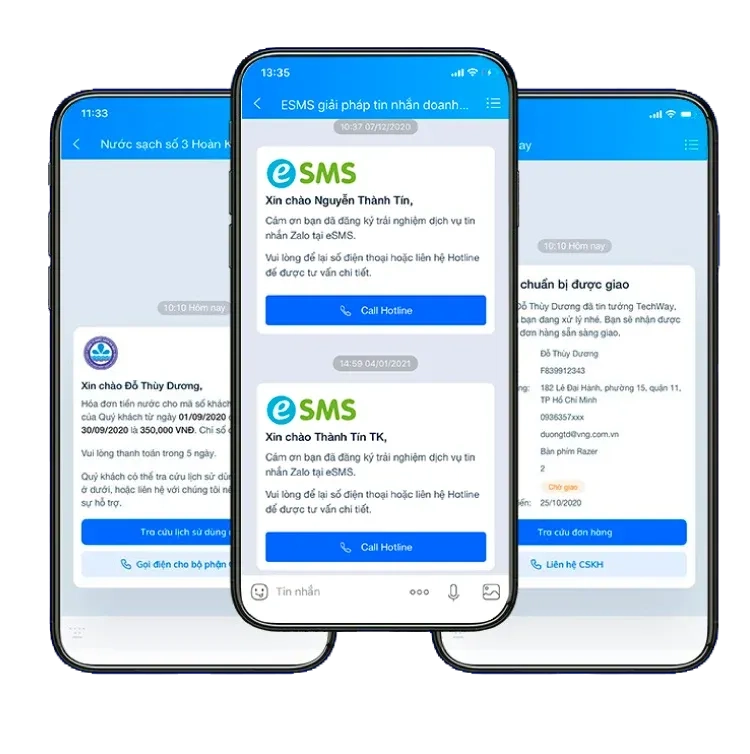
ZNS runs through Zalo's official API documented at developers.zalo.me. The integration typically connects to your e-commerce platform, CRM, booking system, or ERP so messages fire without manual intervention.
Why Do Businesses Use ZNS Instead Of SMS?
Businesses in Vietnam switch from SMS to ZNS mainly because ZNS delivers at higher rates for lower cost, supports richer message content, and reaches customers in the app they already use daily.
Here are 4 practical reasons why ZNS is beneficial:
- Delivery rates: Standard SMS routes in Vietnam have seen declining delivery quality as consumers install spam blockers and carriers filter aggressively. ZNS routes through Zalo's app infrastructure and bypasses SMS filtering entirely.
- Content format: SMS limits you to 160 plain-text characters (fewer with Vietnamese Unicode). ZNS templates support structured fields, images, action buttons, and clickable links, making messages more actionable.
- Cost per message: ZNS transactional pricing typically comes in below SMS Brandname for the same volume, especially at higher monthly send counts.
- User attention: Vietnamese consumers check Zalo dozens of times per day out of habit. Messages landing in Zalo get seen faster than SMS sitting in an unmonitored inbox.
For businesses running high-volume transactional flows (e-commerce order confirmations, banking OTPs, booking reminders), the combined savings and delivery quality often justify migration within the first quarter of use. Businesses just starting on the Zalo ecosystem should first understand how Zalo OA works as the foundation, since ZNS registration requires an approved OA as a prerequisite.
Types Of ZNS Messages
Zalo categorizes ZNS messages by purpose, with different approval rules, pricing, and content restrictions for each:
- Transactional Messages: Order confirmations, payment receipts, shipping updates, OTP codes. Lowest per-message cost, fastest approval, strictest content requirements. Content must directly relate to a completed transaction or authentication event.
- Care Messages: Appointment reminders, service notifications, membership updates, loyalty balance updates. Mid-tier pricing, moderate content flexibility, supports ongoing customer relationship touches.
- Promotional Messages: Marketing offers, product announcements, campaign notifications. Highest per-message cost, requires explicit customer opt-in, subject to time-of-day sending restrictions similar to Decree 91/2020 for SMS marketing.
Sending the wrong message category (for example, wrapping promotional content in a transactional template) violates Zalo policy and can suspend your ZNS access. Foreign businesses should categorize templates carefully at design time to avoid mid-operation disruptions.
How Does ZNS Compare To SMS Brandname?
ZNS and SMS Brandname both deliver verified messages to Vietnamese phone numbers, but they run on different infrastructure, cost different amounts, and suit different scenarios.
| Criteria | ZNS | SMS Brandname |
|---|---|---|
| Infrastructure | Zalo app | Mobile carrier SMS network |
| Recipient requirement | Zalo installed on the phone | Any active mobile number |
| Cost per message | Lower for most categories | Higher, especially promotional |
| Content format | Text, images, buttons, structured fields | Plain text only, 160 characters |
| Promotional send hours | Per Zalo policy | 7 AM to 10 PM (Decree 91/2020) |
| Reach guarantee | Zalo users only | All active mobile subscribers |
| Best suited for | Vietnamese consumers with Zalo | Segments without Zalo, critical guaranteed reach |
Vietnamese businesses often run both channels in parallel: ZNS as the primary channel for cost efficiency and rich formatting, SMS Brandname as fallback for phone numbers without Zalo or for critical messages where guaranteed reach matters more than cost. Foreign businesses starting fresh typically begin with ZNS since it covers the majority of Vietnamese consumers at lower cost, then layer SMS on top when specific delivery gaps appear.
How Much Does ZNS Cost?
ZNS runs on a pay-per-successful-delivery model, with per-message rates determined by message category, monthly volume tier, and whether you buy direct from Zalo or through a partner. Failed sends are not charged.
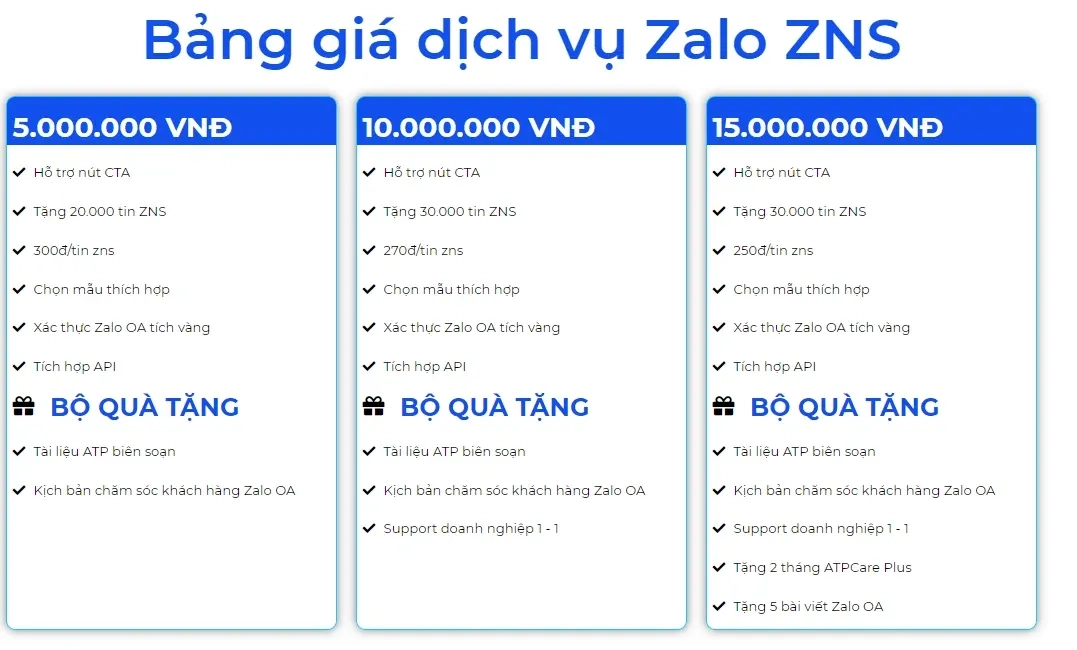
Here are what included in Zalo ZNS cost:
- Message category mix: Transactional messages are cheapest, followed by Care, then Promotional. Your final cost depends on what percentage of your volume sits in each category.
- Monthly volume tier: Higher committed volume unlocks better per-message rates. Businesses sending over 100,000 messages monthly typically qualify for volume discounts.
- Direct vs partner: Buying directly from Zalo gives base pricing. Working through a Zalo-authorized ZNS partner (such as CNV Loyalty, Callio, VietGuys, Stringee, BlueData) adds a service markup but includes template management, integration support, and dashboard tools.
- Template features: Templates with CTA buttons or advanced formatting may carry small fee premiums over basic text templates.
For budgeting, model your expected monthly volume by message type and request quotes from 2-3 ZNS partners to compare total cost including their service fees.
How To Register For ZNS
Registration runs through Zalo's developer portal and typically takes 5-10 business days from application to first live message. Five steps to activate ZNS:
Step 1: Verify Your Zalo OA Is Active
ZNS registration requires an active, verified Zalo OA as prerequisite. If your business does not have one yet, complete OA verification before starting ZNS registration.
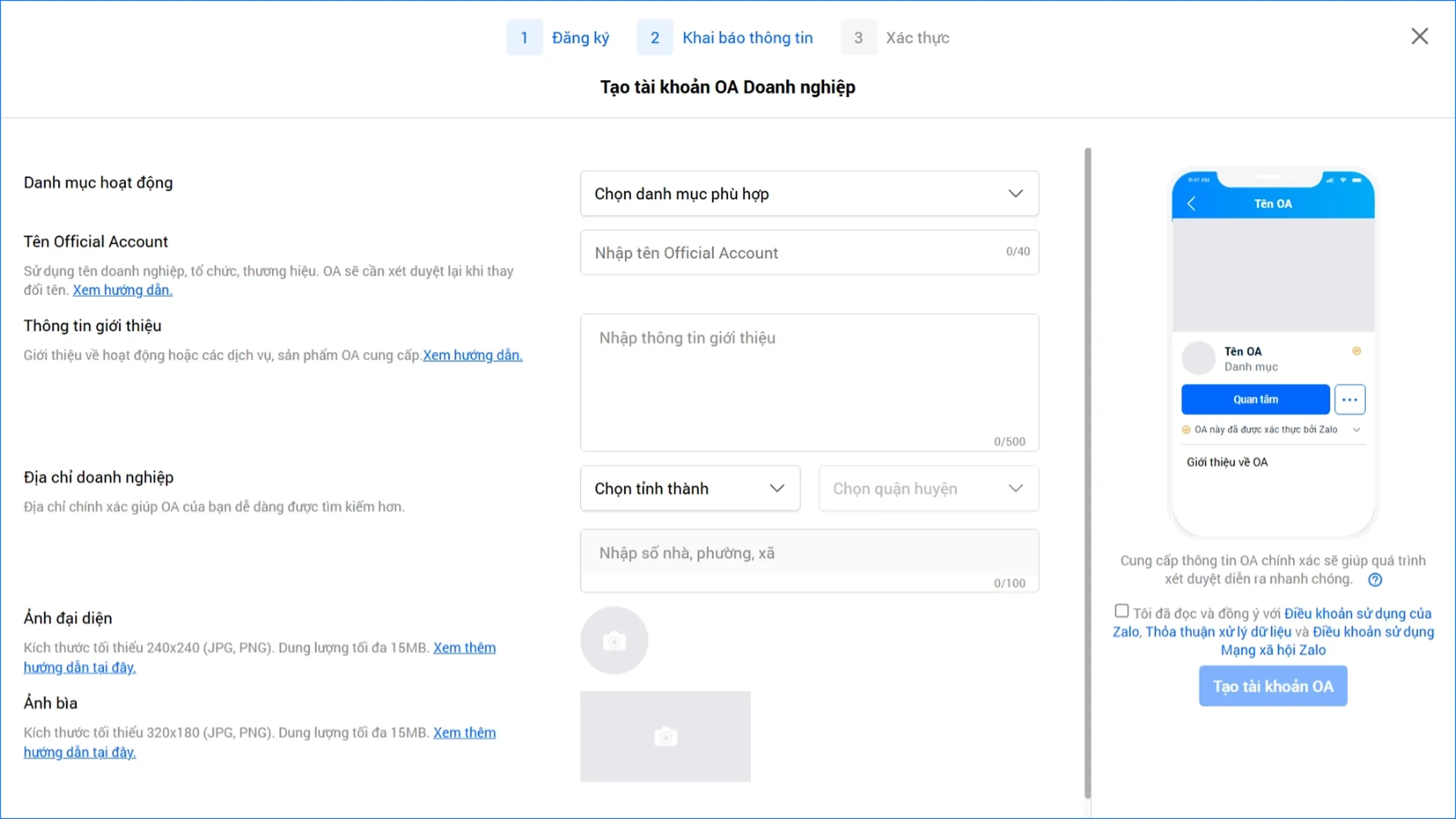
Step 2: Register As A ZNS Developer
Go to Zalo Developers and register a developer account linked to your OA. This gives access to the API documentation, sandbox environment, and template management dashboard.
Step 3: Choose Direct Integration Or A Partner
Two paths, choose based on your technical resources:
- Direct API integration: Your development team builds the integration in-house. Suits businesses with strong technical resources and predictable message volume above 50,000 per month.
- ZNS partner integration: Work with a Zalo-authorized partner who provides pre-built integrations, template management interfaces, and Vietnamese support. Suits businesses without local technical staff or those wanting faster time-to-launch.
Step 4: Submit Message Templates For Approval
Every ZNS message you send must use a pre-approved template. Templates define the structure, variable fields, and category. Zalo reviews templates within 1-3 business days. Rejected templates return with specific feedback on adjustments needed.
Step 5: Integrate The API And Test In Sandbox
Connect your business systems to the ZNS API endpoint and test each template in the sandbox environment before switching to production. Monitor delivery rates weekly during the first month to catch integration issues before they affect customer experience.
Common Mistakes To Avoid With ZNS
Businesses new to ZNS often repeat the same mistakes in the first months of operation. Watching for these upfront saves substantial rework:
- Mixing message categories in one template: Templates that blend transactional and promotional content get rejected or, worse, approved and later suspended when Zalo flags misuse patterns.
- Skipping sandbox testing: Bugs that make it to production waste API calls, deliver malformed messages to real customers, and erode trust in your notification channel.
- Translating English templates word-for-word: Direct translations read stiffly in Vietnamese and often violate Zalo's content guidelines on natural language. Have templates reviewed by a native Vietnamese speaker familiar with your industry.
- No fallback for critical messages: OTP codes and urgent alerts should route to SMS Brandname automatically when ZNS delivery fails. Skipping fallback logic creates gaps that only surface when customers complain.
- Ignoring delivery rate monitoring: Sustained delivery rates below 90% usually signal template issues, phone number quality problems, or account standing concerns that need investigation before they compound.
Managing Customer Replies After ZNS Notifications
ZNS is a one-way channel by design, an order confirmation gets sent, an OTP gets delivered, then the message stream ends. In practice, Vietnamese customers frequently reply to ZNS notifications with follow-up questions, sending those replies to your Zalo OA chat inbox. Those inbound replies do not surface in your ZNS dashboard because that dashboard tracks outbound delivery only.
SaleSmartly integrates those Zalo replies alongside messages from your other customer channels, showing which ZNS notification triggered each conversation so your team responds with full context instead of asking customers to repeat themselves. For foreign businesses, real-time translation across 130+ languages lets founders and managers read Vietnamese replies in English and reply back in English while customers see the message in Vietnamese.
If your ZNS-driven volume is producing more inbound follow-ups than your team can track manually, connecting Zalo replies into a single managed inbox closes the loop between outbound notification and inbound conversation.
Conclusion
ZNS has emerged as the most cost-effective transactional messaging channel for reaching Vietnamese consumers, with higher delivery rates than SMS at lower cost and richer content formats. For foreign businesses in Vietnam, the practical entry path is activating your Zalo OA first, choosing between direct integration or a ZNS partner based on your technical resources, submitting clean templates for approval, and starting with transactional messages before expanding to care and promotional categories.
What Is Zalo OA? Definition, Account Types, And How To Create One
What is Zalo OA? Learn Zalo Official Account types, messaging limits, real costs, and step-by-step setup for foreign businesses operating in Vietnam.
What Is CSAT? Definition, Formula, Benchmarks, And How To Measure It Well
What is CSAT? Learn the CSAT formula, how to read benchmark scores, differences from NPS and CES, and common mistakes teams make when measuring satisfaction.
